Wave-Particle Duality: Light
Does light consist of particles or waves? When one focuses upon the different types of phenomena observed with light, a strong case can be built for a wave picture:
 Interference |  Diffraction | 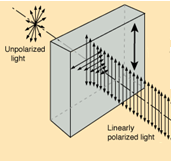 Polarization |
By the turn of the 20th century, most physicists were convinced by phenomena like the above that light could be fully described by a wave, with no necessity for invoking a particle nature. But the story was not over.
| Phenomenon | Can be explained in terms of waves. | Can be explained in terms of particles. |
| Reflection |  |  |
| Refraction | | |
| Interference | |  |
| Diffraction | | |
| Polarization | | |
| Photoelectric effect |  | |
Most commonly observed phenomena with light can be explained by waves. But the photoelectric effect suggested a particle nature for light. Then electrons too were found to exhibit dual natures.

Sem comentários:
Enviar um comentário